 BirdBrain Academy
Hummingbirds · Trochilidae
Ruby-throated Hummingbird sounds
Archilochus colubris
The Ruby-throated Hummingbird is eastern North America's common hummingbird, breeding in summer and wintering from Florida to Central America.

Listen to the Ruby-throated Hummingbird
Each recording below is a short excerpt with its spectrogram, a picture of the sound. Time runs left to right and higher pitches sit higher up. Play each one, then look for the same shape in the next. Different recordings of the same bird help you learn the bird, not one clip.

Recorded by Jonathon Jongsma, Minnesota Valley NWR, Old Cedar Ave Bridge, Hennepin, Minnesota, 2012-09-01. XC109598 on xeno-canto, CC BY-SA 3.0. Five-second excerpt.

Recorded by Jonathon Jongsma, Minnesota Valley NWR, Old Cedar Ave Bridge, Hennepin, Minnesota, 2012-09-01. XC109597 on xeno-canto, CC BY-SA 3.0. Five-second excerpt.

Recorded by Jonathon Jongsma, Minnesota Valley NWR, Old Cedar Ave Bridge, Hennepin, Minnesota, 2012-09-01. XC109598 on xeno-canto, CC BY-SA 3.0. Five-second excerpt.
What to listen for
Its vocalizations are rapid, squeaky chirps used mainly for threats, such as warning another male from a territory. During courtship, males also make wing and tail sounds in shuttle and dive displays.
Many listeners write its call as “tik-tik tik-tik tik-tik”. Treat a written sound as a memory aid; individual birds and regions vary.
What it looks like
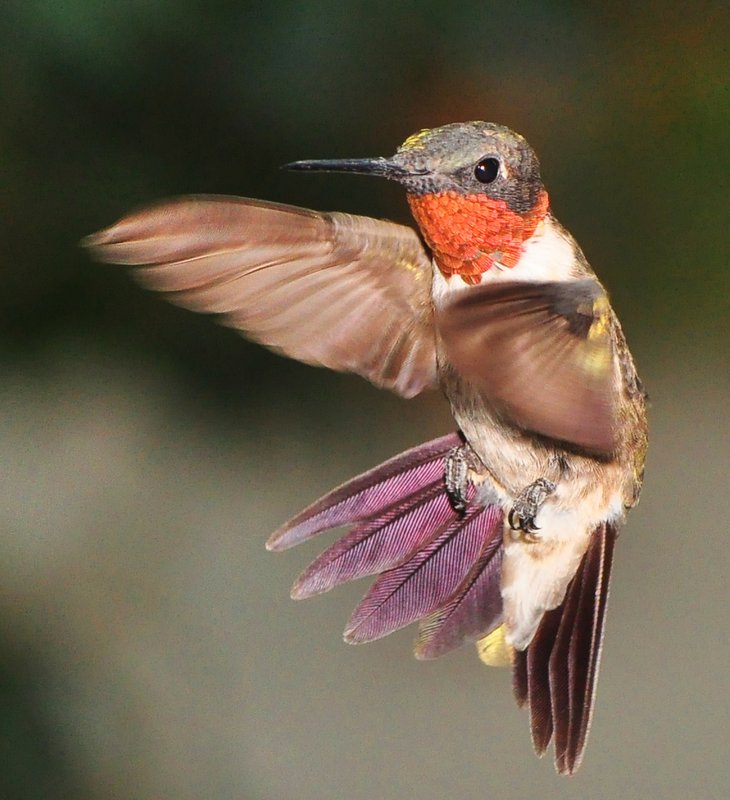
The Ruby-throated Hummingbird is 7 to 9 cm long, metallic green above and grayish white below, with near-black wings and a long, straight, slender bill. Males have an iridescent ruby-red throat bordered with black and a forked black tail, while females have a white throat and a notched, banded tail.
Where to find it
It breeds across much of the eastern United States and south-central to southeastern Canada in deciduous and pine forests, forest edges, orchards, and gardens. Solitary and often aggressive, it defends feeding territories while migrating between breeding grounds and wintering areas in Florida, southern Mexico, Central America, and the West Indies.
BirdBrain regions that include this bird
- Caribbean
- Central America
- Eastern Canada
- Florida
- Great Lakes
- Mexico
- Mid-Atlantic
- New England
- Plains
- Polynesia
- Southeast
- Texas
- Western Canada
Did you know?
- Some migrants make a nonstop 900-mile journey across the Gulf of Mexico and Caribbean.
- Ruby-throated Hummingbirds may double their fat mass before the Gulf crossing, then spend it during about 20 hours without food or water.
- Their heart rate can reach up to 1260 beats per minute.
Learn the Ruby-throated Hummingbird by ear
BirdBrain Academy teaches bird sounds with side-by-side listening and quizzes that use different recordings, so you learn the bird rather than one clip. Start with six free lessons, no signup needed. On your phone, Sound ID can name the birds singing around you.
Related birds
 Anna's HummingbirdHummingbirds
 American AvocetShorebirds
 American CrowCorvids
 American GoldfinchFinches
 American KestrelFalcons
 American RobinThrushes
Species notes are adapted from Wikipedia, available under CC BY-SA 4.0, and checked for BirdBrain. Recordings come from xeno-canto under the licenses shown with each one. Photo: jeffreyw, CC BY 2.0, via Wikimedia Commons. Identification guidance is educational; birds vary, so confirm unusual sightings with local experts or eBird.