 BirdBrain Academy
Falcons · Falconidae
American Kestrel sounds
Falco sparverius
The American Kestrel is North America's smallest and most common falcon, a colorful hunter of open country across the Americas.

Listen to the American Kestrel
Each recording below is a short excerpt with its spectrogram, a picture of the sound. Time runs left to right and higher pitches sit higher up. Play each one, then look for the same shape in the next. Different recordings of the same bird help you learn the bird, not one clip.

Recorded by Jonathon Jongsma, Four Mile Draw Rd, Custer State Park, South Dakota, 2015-06-26. XC254589 on xeno-canto, CC BY-SA 4.0. Five-second excerpt.

Recorded by Jonathon Jongsma, Four Mile Draw Rd, Custer State Park, South Dakota, 2015-06-25. XC254588 on xeno-canto, CC BY-SA 4.0. Five-second excerpt.

Recorded by Niels Krabbe, Azuay: upper Yunguilla Valley, 2004-03-01. XC250844 on xeno-canto, CC BY-SA 4.0. Five-second excerpt.
What to listen for
The American Kestrel has three basic vocalizations: the klee or killy, the whine, and the chitter. The klee comes in a rapid series when it is upset or excited, while the whine is tied mostly to feeding and the chitter to pair and family interactions.
Many listeners write its call as “klee”. Treat a written sound as a memory aid; individual birds and regions vary.
What it looks like
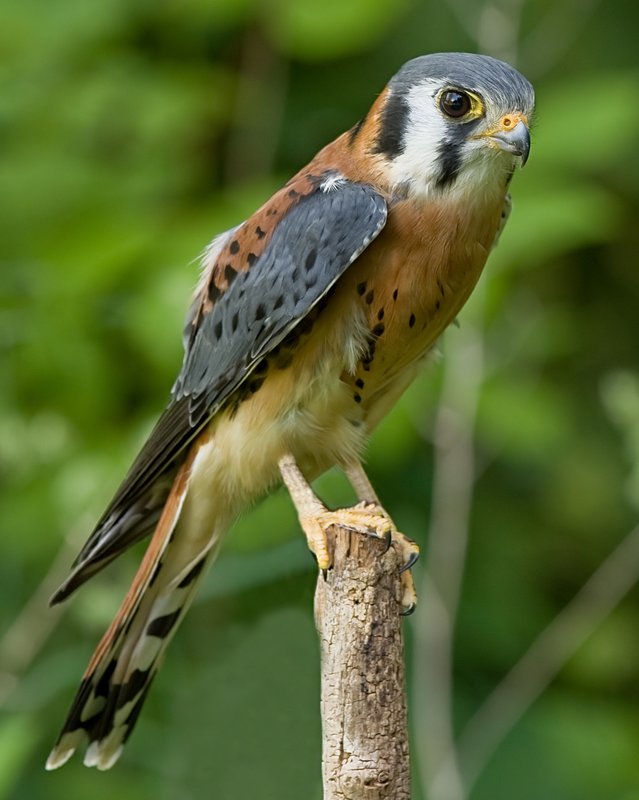
The American Kestrel is a small, lean raptor, 22 to 31 cm long, with pointed wings and strong talons. Males have blue-gray wings, a rufous barred back, spotted white underparts, and a rufous tail, while females are more heavily barred in rufous and brown with creamy to buff streaked undersides.
Where to find it
It lives in grasslands, meadows, deserts, open to semi-open country, and even urban or suburban areas, so long as there are perches, open hunting space, and nesting cavities. It hunts by watching from a perch or hovering on rapid wingbeats before dropping toward prey.
BirdBrain regions that include this bird
- Alaska
- Amazon Basin
- Andean Region
- California
- Caribbean
- Central America
- Eastern Canada
- Eastern South America
- Florida
- Great Lakes
- Mexico
- Mid-Atlantic
- New England
- Northern South America
- Northwest
- Plains
- Polynesia
- Rocky Mountains
- Southeast
- Southern South America
- Southwest
- Texas
- Western Canada
Did you know?
- The American Kestrel is the only kestrel found in the Americas.
- Two dark nape spots may act as false eyes against potential attackers.
- It is commonly used in falconry, especially by beginners.
Learn the American Kestrel by ear
BirdBrain Academy teaches bird sounds with side-by-side listening and quizzes that use different recordings, so you learn the bird rather than one clip. Start with six free lessons, no signup needed. On your phone, Sound ID can name the birds singing around you.
Related birds
 American AvocetShorebirds
 American CrowCorvids
 American GoldfinchFinches
 American RobinThrushes
 American Tree SparrowSparrows
 American White PelicanPelicans
Species notes are adapted from Wikipedia, available under CC BY-SA 4.0, and checked for BirdBrain. Recordings come from xeno-canto under the licenses shown with each one. Photo: Photo by Greg Hume (Greg5030), CC BY-SA 3.0, via Wikimedia Commons. Identification guidance is educational; birds vary, so confirm unusual sightings with local experts or eBird.