 BirdBrain Academy
Thrushes · Turdidae
American Robin sounds
Turdus migratorius
The American Robin is a widespread North American migratory thrush with a reddish-orange breast and a familiar dawn song.

Listen to the American Robin
Each recording below is a short excerpt with its spectrogram, a picture of the sound. Time runs left to right and higher pitches sit higher up. Play each one, then look for the same shape in the next. Different recordings of the same bird help you learn the bird, not one clip.

Recorded by Eric B, Arlington, Middlesex County, Massachusetts, 2020-06-16. XC569292 on xeno-canto, CC BY-SA 4.0. Five-second excerpt.

Recorded by Jonathon Jongsma, Blue Bell Campground, Custer State Park, South Dakota, 2015-06-23. XC254484 on xeno-canto, CC BY-SA 4.0. Five-second excerpt.

Recorded by Jonathon Jongsma, Blue Bell Campground, Custer State Park, South Dakota, 2015-06-23. XC254483 on xeno-canto, CC BY-SA 4.0. Five-second excerpt.
What to listen for
The male has a complex, almost continuous song, commonly described as a cheery carol of repeated discrete units with brief pauses. It also uses calls to communicate threats, including approaching ground predators or danger near a nest.
When you are most likely to hear it: Late February or early March to late July or early August, often at dawn or before and again as evening sets in.
What it looks like
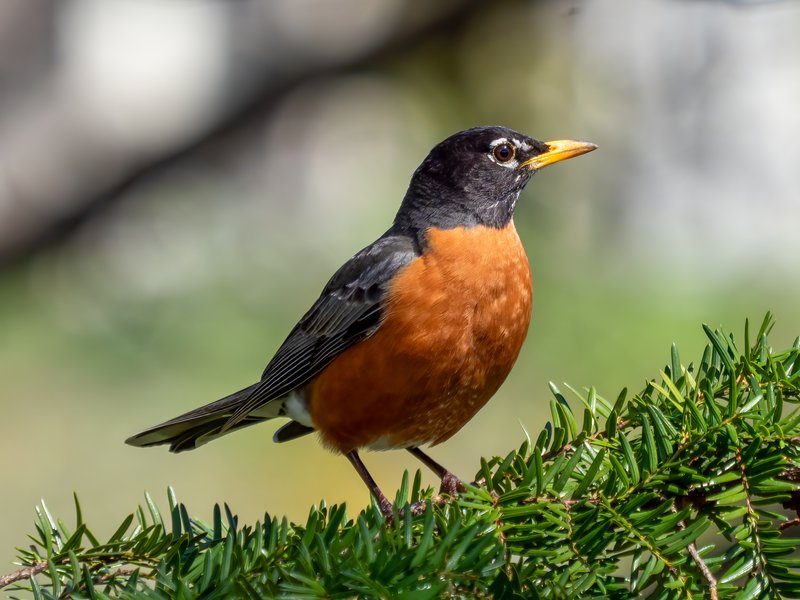
The American Robin is 23 to 28 cm long, with a brown back, reddish-orange breast, white belly and undertail coverts, and white eye arcs. Its head ranges from jet black to gray, the throat is white with black streaks, and females tend to be duller than males.
Where to find it
It breeds across most of North America in woodland, open farmland, and urban areas, wintering south of Canada to central Mexico and along the Pacific Coast. Active mostly by day, it gathers in large winter roosts at night and feeds in smaller groups by day.
BirdBrain regions that include this bird
- Alaska
- California
- Eastern Canada
- Florida
- Great Lakes
- Mexico
- Mid-Atlantic
- New England
- Northwest
- Plains
- Polynesia
- Rocky Mountains
- Southeast
- Southwest
- Texas
- Western Canada
Did you know?
- According to Partners in Flight, it is the most abundant landbird in North America, with about 370 million individuals.
- It is among the earliest birds to sing at dawn.
- When feeding in flocks, it can watch other birds for reactions to predators.
Learn the American Robin by ear
BirdBrain Academy teaches bird sounds with side-by-side listening and quizzes that use different recordings, so you learn the bird rather than one clip. Start with six free lessons, no signup needed. On your phone, Sound ID can name the birds singing around you.
Related birds
 Eastern BluebirdThrushes
 Western BluebirdThrushes
 American AvocetShorebirds
 American CrowCorvids
 American GoldfinchFinches
 American KestrelFalcons
Species notes are adapted from Wikipedia, available under CC BY-SA 4.0, and checked for BirdBrain. Recordings come from xeno-canto under the licenses shown with each one. Photo: Rhododendrites, CC BY-SA 4.0, via Wikimedia Commons. Identification guidance is educational; birds vary, so confirm unusual sightings with local experts or eBird.