 BirdBrain Academy
Shorebirds · Recurvirostridae
American Avocet sounds
Recurvirostra americana
The American Avocet is a large North American wader that sweeps its upturned bill through shallow water for prey.

Listen to the American Avocet
Each recording below is a short excerpt with its spectrogram, a picture of the sound. Time runs left to right and higher pitches sit higher up. Play each one, then look for the same shape in the next. Different recordings of the same bird help you learn the bird, not one clip.

Recorded by Jonathon Jongsma, Palo Alto Baylands, Santa Clara, California, 2012-04-21. XC99571 on xeno-canto, CC BY-SA 3.0. Five-second excerpt.

Recorded by Robert Benson, Corpus Christi, Nueces County, Texas, 1999-02-06. XC756851 on xeno-canto, CC BY-SA 4.0. Five-second excerpt.

Recorded by Jonathon Jongsma, Palo Alto Baylands, Santa Clara, California, 2012-04-21. XC133080 on xeno-canto, CC BY-SA 3.0. Five-second excerpt.
What to listen for
Its voice is described as a shrill yet melodic alarm that rises in inflection. American Avocets use common, excited, and broken-wing calls.
Many listeners write its call as “bweet”. Treat a written sound as a memory aid; individual birds and regions vary.
What it looks like
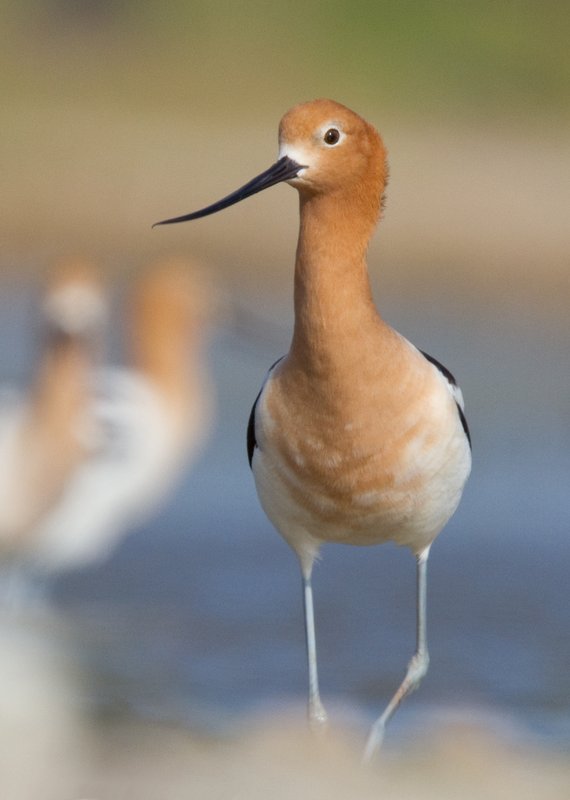
The American Avocet is 40-51 cm long, with long pale blue-gray legs and a long black bill curved slightly upward. Its back is black and white, its belly white, and breeding birds show brassy orange on the head and neck.
Where to find it
It forages in shallow water, mud flats, marshes, beaches, prairie ponds, and shallow lakes, sweeping its bill from side to side for crustaceans and insects. Breeding occurs from freshwater to hypersaline wetlands, and wintering is mainly coastal.
BirdBrain regions that include this bird
- California
- Eastern Canada
- Florida
- Great Lakes
- Mexico
- Mid-Atlantic
- New England
- Northwest
- Plains
- Polynesia
- Southeast
- Texas
- Western Canada
Did you know?
- Its pastel gray-blue legs give it the colloquial name blue shanks.
- Some American Avocets parasitize other birds' nests.
- When diving at predators, avocets may simulate the Doppler effect with their calls.
Learn the American Avocet by ear
BirdBrain Academy teaches bird sounds with side-by-side listening and quizzes that use different recordings, so you learn the bird rather than one clip. Start with six free lessons, no signup needed. On your phone, Sound ID can name the birds singing around you.
Related birds
 Black-necked StiltShorebirds
 Greater YellowlegsShorebirds
 Lesser YellowlegsShorebirds
 Wilson's SnipeShorebirds
Species notes are adapted from Wikipedia, available under CC BY-SA 4.0, and checked for BirdBrain. Recordings come from xeno-canto under the licenses shown with each one. Photo: Dan Pancamo, CC BY-SA 2.0, via Wikimedia Commons. Identification guidance is educational; birds vary, so confirm unusual sightings with local experts or eBird.