 BirdBrain Academy
Thrushes · Turdidae
Eastern Bluebird sounds
Sialia sialis
A small North American migratory thrush, the Eastern Bluebird favors open woodlands, farmlands, and orchards.

Listen to the Eastern Bluebird
Each recording below is a short excerpt with its spectrogram, a picture of the sound. Time runs left to right and higher pitches sit higher up. Play each one, then look for the same shape in the next. Different recordings of the same bird help you learn the bird, not one clip.

Recorded by Jonathon Jongsma, Murphy-Hanrehan Park Reserve, Dakota, Minnesota, 2014-05-25. XC179669 on xeno-canto, CC BY-SA 4.0. Five-second excerpt.

Recorded by Jonathon Jongsma, Powderhorn Park, Minneapolis, Hennepin, Minnesota, 2012-04-30. XC100032 on xeno-canto, CC BY-SA 3.0. Five-second excerpt.

Recorded by Jonathon Jongsma, Murphy-Hanrehan Park Reserve, Dakota, Minnesota, 2014-05-25. XC179669 on xeno-canto, CC BY-SA 4.0. Five-second excerpt.
What to listen for
The male gives sometimes soft warbles, and its song is described as melodious. Near predators, males give a song-like warning cry, while both sexes may warble.
Many listeners write its call as “jeew”. Treat a written sound as a memory aid; individual birds and regions vary.
What it looks like
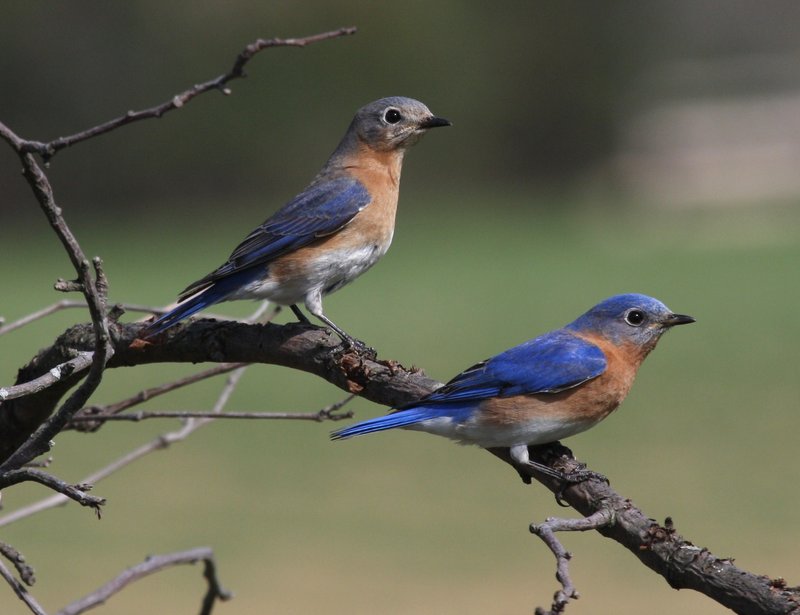
Eastern Bluebirds measure 16–21 cm long, with a 25–32 cm wingspan. Males have bright blue head, back, and wings with a brownish red breast; females are grayer with blue on the wings and tail and a lighter orange breast.
Where to find it
The Eastern Bluebird lives in open country around trees, with little understory and sparse ground cover, including pastures, agricultural fields, suburban parks, backyards, and golf courses. They are social and may gather in flocks of over a hundred, but become territorial during breeding season and may defend feeding areas in winter.
BirdBrain regions that include this bird
- Central America
- Eastern Canada
- Florida
- Great Lakes
- Mexico
- Mid-Atlantic
- New England
- Plains
- Polynesia
- Rocky Mountains
- Southeast
- Southwest
- Texas
- Western Canada
Did you know?
- The Eastern Bluebird is the state bird of Missouri and New York.
- Some Eastern Bluebirds gather in flocks of over a hundred.
- An isolated Bermuda subspecies has brighter blue coloration than mainland populations.
Learn the Eastern Bluebird by ear
BirdBrain Academy teaches bird sounds with side-by-side listening and quizzes that use different recordings, so you learn the bird rather than one clip. Start with six free lessons, no signup needed. On your phone, Sound ID can name the birds singing around you.
Related birds
 American RobinThrushes
 Western BluebirdThrushes
 American AvocetShorebirds
 American CrowCorvids
 American GoldfinchFinches
 American KestrelFalcons
Species notes are adapted from Wikipedia, available under CC BY-SA 4.0, and checked for BirdBrain. Recordings come from xeno-canto under the licenses shown with each one. Photo: Sandysphotos2009, CC BY 2.0, via Wikimedia Commons. Identification guidance is educational; birds vary, so confirm unusual sightings with local experts or eBird.