 BirdBrain Academy
Hummingbirds · Trochilidae
Anna's Hummingbird sounds
Calypte anna
The Anna's Hummingbird is a North American hummingbird native to western coastal regions, with year-round presence in parts of the Pacific Northwest.

Listen to the Anna's Hummingbird
Each recording below is a short excerpt with its spectrogram, a picture of the sound. Time runs left to right and higher pitches sit higher up. Play each one, then look for the same shape in the next. Different recordings of the same bird help you learn the bird, not one clip.

Recorded by Jonathon Jongsma, Picchetti Ranch Open Space Preserve, Santa Clara, California, 2012-09-09. XC109852 on xeno-canto, CC BY-SA 3.0. Five-second excerpt.

Recorded by Jonathon Jongsma, McClellan Ranch Preserve, Santa Clara, California, 2012-09-03. XC109651 on xeno-canto, CC BY-SA 3.0. Five-second excerpt.

Recorded by Jonathon Jongsma, Picchetti Ranch Open Space Preserve, Santa Clara, California, 2012-09-09. XC109852 on xeno-canto, CC BY-SA 3.0. Five-second excerpt.
What to listen for
The male’s call is scratchy and metallic, typically given while perched in trees and shrubs. During courtship, his thin, squeaky song is interspersed with buzzes and chirps, and display dives can end with an audible tail-feather squeak.
What it looks like
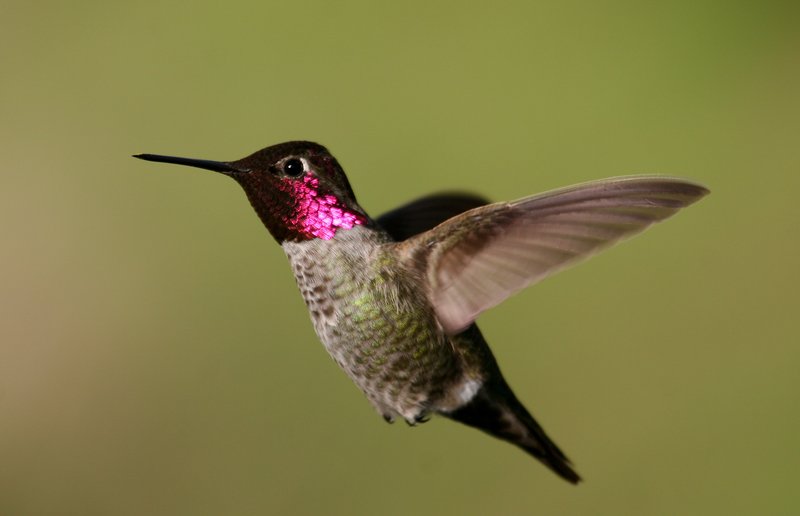
The Anna's Hummingbird is 3.9 to 4.3 inches long, with a bronze-green back, pale gray chest and belly, green flanks, and a long straight bill. Males have an iridescent crimson-red to reddish-pink crown and gorget; females and juveniles are duller, with gray underparts and white-tipped outer tail feathers.
Where to find it
It is found along western North America from southern Canada to northern Baja California, with inland range into Arizona, southern Nevada, southeastern Utah, and western Texas. It feeds on nectar, tree sap, insects, spiders, and sugar-water mixes, and breeds in open wooded or shrubby areas and mountain meadows along the Pacific coast.
BirdBrain regions that include this bird
- Alaska
- Arctic
- California
- Mexico
- Northwest
- Rocky Mountains
- Southeast
- Southwest
- Texas
- Western Canada
Did you know?
- The male is the only North American hummingbird with a red crown.
- Anna's hummingbirds can shake their bodies 55 times per second to shed rain, pollen, or dirt.
- Females bind nest materials together with spider silk and may camouflage nests with lichen, plant debris, or urban scraps.
Learn the Anna's Hummingbird by ear
BirdBrain Academy teaches bird sounds with side-by-side listening and quizzes that use different recordings, so you learn the bird rather than one clip. Start with six free lessons, no signup needed. On your phone, Sound ID can name the birds singing around you.
Related birds
 Ruby-throated HummingbirdHummingbirds
 American AvocetShorebirds
 American CrowCorvids
 American GoldfinchFinches
 American KestrelFalcons
 American RobinThrushes
Species notes are adapted from Wikipedia, available under CC BY-SA 4.0, and checked for BirdBrain. Recordings come from xeno-canto under the licenses shown with each one. Photo: Robert McMorran, United States Fish and Wildlife Service, Public domain, via Wikimedia Commons. Identification guidance is educational; birds vary, so confirm unusual sightings with local experts or eBird.