 BirdBrain Academy
Finches · Fringillidae
Purple Finch sounds
Haemorhous purpureus
The Purple Finch is a North American finch breeding across northern forests and the Pacific coast.
Listen to the Purple Finch
Each recording below is a short excerpt with its spectrogram, a picture of the sound. Time runs left to right and higher pitches sit higher up. Play each one, then look for the same shape in the next. Different recordings of the same bird help you learn the bird, not one clip.

Recorded by Doug Hynes, Whitbourne, Newfoundland and Labrador, 2011-03-11. XC935606 on xeno-canto, CC BY-SA 4.0. Five-second excerpt.


What to listen for
What it looks like
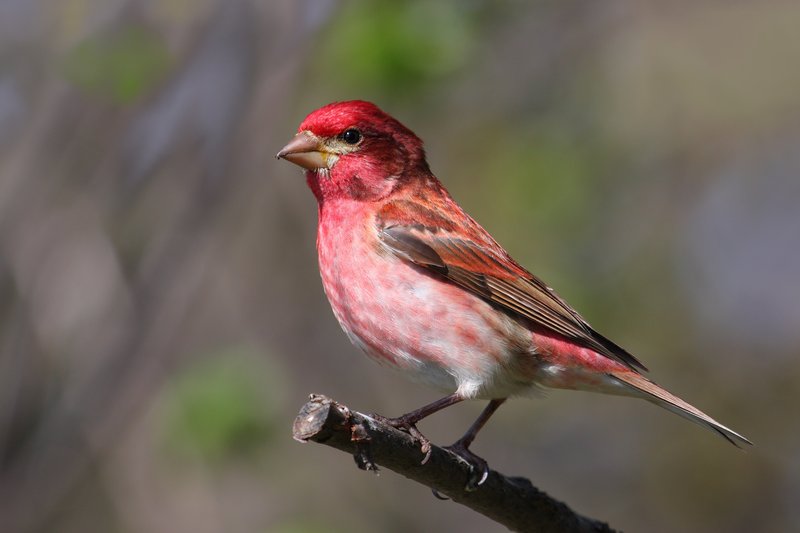
The Purple Finch is 12–16 cm long, with a short forked brown tail and brown wings. Males are raspberry red on the head, breast, back, and rump, while females are light brown above and white below with dark streaking and a pale line over the eye.
Where to find it
It breeds in coniferous and mixed forests in Canada and the northeastern United States, and in wooded areas along the U.S. Pacific coast. It forages in trees and bushes, sometimes on ground vegetation, eating seeds, berries, and insects.
BirdBrain regions that include this bird
- Alaska
- California
- Eastern Canada
- Florida
- Great Lakes
- Mexico
- Mid-Atlantic
- New England
- Northwest
- Plains
- Rocky Mountains
- Southeast
- Southwest
- Texas
- Western Canada
Did you know?
- Northern Canadian birds migrate to the southern United States, while others remain year-round.
- The house finch has displaced the Purple Finch from some eastern breeding-season habitats.
- It is fond of sunflower seeds, millet, and thistle.
Learn the Purple Finch by ear
BirdBrain Academy teaches bird sounds with side-by-side listening and quizzes that use different recordings, so you learn the bird rather than one clip. Start with six free lessons, no signup needed. On your phone, Sound ID can name the birds singing around you.
Related birds
 American GoldfinchFinches
 House FinchFinches
 American AvocetShorebirds
 American CrowCorvids
 American KestrelFalcons
 American RobinThrushes
Species notes are adapted from Wikipedia, available under CC BY-SA 4.0, and checked for BirdBrain. Recordings come from xeno-canto under the licenses shown with each one. Photo: Cephas, CC BY-SA 3.0, via Wikimedia Commons. Identification guidance is educational; birds vary, so confirm unusual sightings with local experts or eBird.