 BirdBrain Academy
Ospreys · Pandionidae
Osprey sounds
Pandion haliaetus
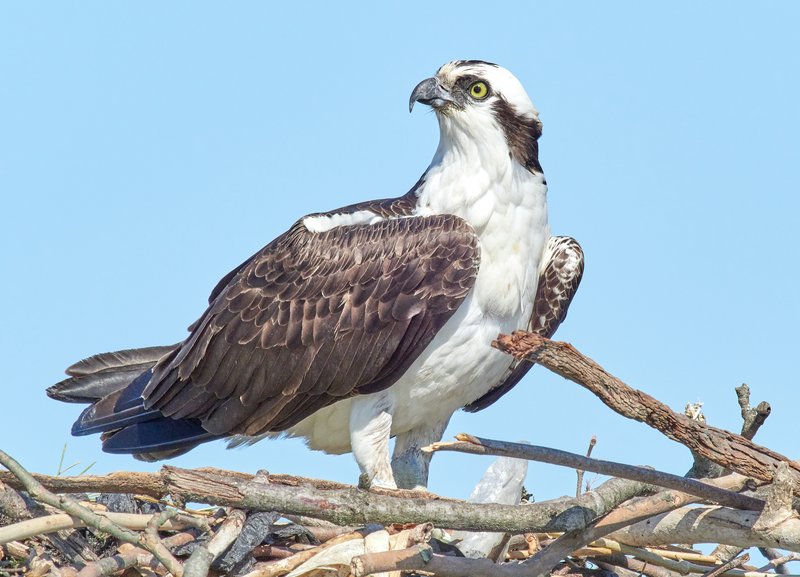
The Osprey is a large, diurnal, fish-eating raptor with a cosmopolitan range and distinctive brown and pale plumage.

Listen to the Osprey
Each recording below is a short excerpt with its spectrogram, a picture of the sound. Time runs left to right and higher pitches sit higher up. Play each one, then look for the same shape in the next. Different recordings of the same bird help you learn the bird, not one clip.

Recorded by Doug Hynes, Owls Head, Nova Scotia, 2021-06-30. XC671347 on xeno-canto, CC BY-SA 4.0. Five-second excerpt.

Recorded by Doug Hynes, Owls Head, Nova Scotia, 2021-07-09. XC670561 on xeno-canto, CC BY-SA 4.0. Five-second excerpt.

Recorded by Doug Hynes, Owls Head, Nova Scotia, 2021-06-30. XC671347 on xeno-canto, CC BY-SA 4.0. Five-second excerpt.
What to listen for
The Osprey gives a series of sharp whistles. When disturbed near the nest, its voice becomes a frenzied call.
Many listeners write its call as “cheep, cheep”. Treat a written sound as a memory aid; individual birds and regions vary.
What it looks like
The Osprey is 50–66 cm long, with a 127–180 cm wingspan, deep glossy brown upperparts, white underparts, and a white head marked by a dark eye mask. In flight, arched wings, drooping hands, black wrists below, and long narrow wings give it a distinctive outline.
Where to find it
The Osprey lives in temperate and tropical regions on every continent except Antarctica, using varied habitats near water with enough fish. It hunts by hovering over water, then plunging feet first, often submerging completely to seize fish.
BirdBrain regions that include this bird
- Alaska
- Amazon Basin
- Andean Region
- Australia
- California
- Caribbean
- Central America
- East Asia
- Eastern Africa
- Eastern Canada
- Eastern Europe
- Eastern South America
- Florida
- Great Lakes
- Melanesia
- Mexico
- Mid-Atlantic
- Middle East
- New England
- Northern Africa
- Northern Europe
- Northern South America
- Northwest
- Plains
- Polynesia
- Rocky Mountains
- South Asia
- Southeast
- Southern Europe
- Southwest
- Texas
- Western Africa
- Western Canada
- Western Europe
- Western Russia
Did you know?
- Fish make up 99% of the Osprey's diet.
- It is the second-most widely distributed raptor species, after the peregrine falcon.
- Its reversible outer toes help it grip slippery fish with two toes in front and two behind.
Learn the Osprey by ear
BirdBrain Academy teaches bird sounds with side-by-side listening and quizzes that use different recordings, so you learn the bird rather than one clip. Start with six free lessons, no signup needed. On your phone, Sound ID can name the birds singing around you.
Related birds
 American AvocetShorebirds
 American CrowCorvids
 American GoldfinchFinches
 American KestrelFalcons
 American RobinThrushes
 American Tree SparrowSparrows
Species notes are adapted from Wikipedia, available under CC BY-SA 4.0, and checked for BirdBrain. Recordings come from xeno-canto under the licenses shown with each one. Photo: RoySmith, CC BY-SA 4.0, via Wikimedia Commons. Identification guidance is educational; birds vary, so confirm unusual sightings with local experts or eBird.