 BirdBrain Academy
Mimids · Mimidae
Northern Mockingbird sounds
Mimus polyglottos
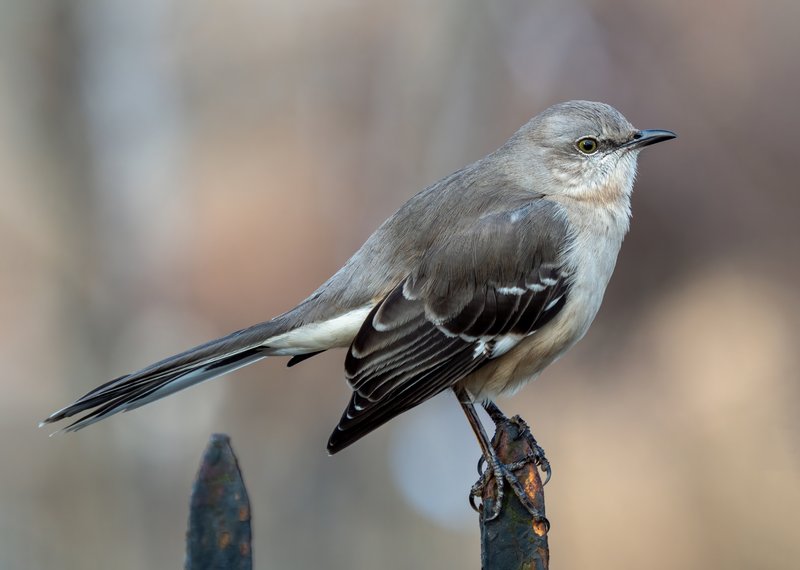
The Northern Mockingbird is a gray North American mimid known for mimicry, white wing patches, and a presence in open urban habitats.

Listen to the Northern Mockingbird
Each recording below is a short excerpt with its spectrogram, a picture of the sound. Time runs left to right and higher pitches sit higher up. Play each one, then look for the same shape in the next. Different recordings of the same bird help you learn the bird, not one clip.

Recorded by Anonymous, Military Academy (near West Point), Orange County, New York, 2024-10-01. XC949194 on xeno-canto, CC0 1.0. Five-second excerpt.

Recorded by Anonymous, Highland Falls, Orange County, New York, 2024-05-14. XC917982 on xeno-canto, CC0 1.0. Five-second excerpt.

Recorded by steve, Chapel Hill, Orange County, North Carolina, 2024-03-25. XC884705 on xeno-canto, CC BY-SA 4.0. Five-second excerpt.
What to listen for
The Northern Mockingbird is best known in North America for imitating other birds, other animals, and artificial sounds such as unoiled wheels and car alarms. Both sexes sing, and the song repertoire can be large and lifelong, while recognized calls include nest relief, hew, chat or chatburst, and begging calls.
Many listeners write its call as “hew”. Treat a written sound as a memory aid; individual birds and regions vary.
When you are most likely to hear it: Males begin singing in late January to February, continuing into summer and territorial song in fall..
What it looks like
The Northern Mockingbird is a medium-sized mimid with long legs and a long tail; males and females look alike. It is gray above and white or whitish-gray below, with white wing patches and white outer tail feathers visible in flight.
Where to find it
It favors open areas with sparse vegetation, including parks, gardens, mowed lawns with nearby shrubs, desert scrub, and chaparral. It forages on the ground or in vegetation and often spreads its wings to show white patches while feeding.
BirdBrain regions that include this bird
- California
- Caribbean
- Eastern Canada
- Florida
- Great Lakes
- Mexico
- Mid-Atlantic
- New England
- Northwest
- Plains
- Polynesia
- Rocky Mountains
- Southeast
- Southwest
- Texas
- Western Canada
- Western Europe
Did you know?
- It can mimic birds, cats, dogs, frogs, crickets, unoiled wheels, and even car alarms.
- Studies show it can identify individual humans and respond differently based on learned threat assessments.
- The Northern Mockingbird is the state bird of five U.S. states.
Learn the Northern Mockingbird by ear
BirdBrain Academy teaches bird sounds with side-by-side listening and quizzes that use different recordings, so you learn the bird rather than one clip. Start with six free lessons, no signup needed. On your phone, Sound ID can name the birds singing around you.
Related birds
 American AvocetShorebirds
 American CrowCorvids
 American GoldfinchFinches
 American KestrelFalcons
 American RobinThrushes
 American Tree SparrowSparrows
Species notes are adapted from Wikipedia, available under CC BY-SA 4.0, and checked for BirdBrain. Recordings come from xeno-canto under the licenses shown with each one. Photo: Rhododendrites, CC BY-SA 4.0, via Wikimedia Commons. Identification guidance is educational; birds vary, so confirm unusual sightings with local experts or eBird.