 BirdBrain Academy
Pigeons and Doves · Columbidae
Mourning Dove sounds
Zenaida macroura
The Mourning Dove is an abundant, widespread North American dove with muted gray-brown plumage, swift flight, and soft, mournful calls.

Listen to the Mourning Dove
Each recording below is a short excerpt with its spectrogram, a picture of the sound. Time runs left to right and higher pitches sit higher up. Play each one, then look for the same shape in the next. Different recordings of the same bird help you learn the bird, not one clip.

Recorded by Jonathon Jongsma, Minnesota Valley NWR, Old Cedar Ave Bridge, Hennepin, Minnesota, 2013-03-31. XC128006 on xeno-canto, CC BY-SA 3.0. Five-second excerpt.

Recorded by Jonathon Jongsma, Minnesota Valley NWR, Old Cedar Ave Bridge, Hennepin, Minnesota, 2013-03-31. XC128006 on xeno-canto, CC BY-SA 3.0. Five-second excerpt.
What to listen for
The Mourning Dove’s call is a distinctive, plaintive coo given by males to attract females and sometimes mistaken for an owl. Close by, a grating throat-rattle may precede the first coo, and the wings whistle in flight.
Many listeners write its call as “cooOOoo-wooo-woo-woooo”. Treat a written sound as a memory aid; individual birds and regions vary.
What it looks like
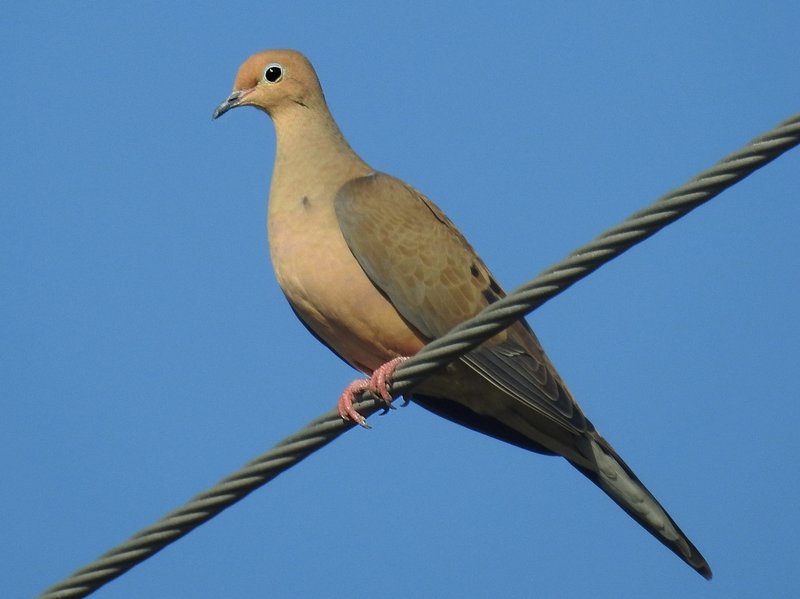
The Mourning Dove is a medium-sized, slender dove about 31 cm long, with broad elliptical wings, a rounded head, and a long tapered tail. Its plumage is light gray-brown above and pinkish below, with black wing spots, white outer tail feathers, and a dark crescent below the eye.
Where to find it
The Mourning Dove lives across the Greater Antilles, most of Mexico, the continental United States, southern Canada, and Bermuda, favoring open and semi-open places such as urban areas, farms, prairie, grassland, and lightly wooded areas. It sunbathes, rain bathes, dustbathes, and roosts communally outside the breeding season.
BirdBrain regions that include this bird
- Alaska
- California
- Caribbean
- Central America
- Eastern Canada
- Florida
- Great Lakes
- Mexico
- Mid-Atlantic
- New England
- Northwest
- Plains
- Polynesia
- Rocky Mountains
- Southeast
- Southwest
- Texas
- Western Canada
Did you know?
- Its wings make an unusual whistling sound during take-off and landing.
- In warm areas, one pair may raise up to six broods in a single year.
- Mourning doves may sunbathe or rain bathe with one wing stretched for up to twenty minutes.
Learn the Mourning Dove by ear
BirdBrain Academy teaches bird sounds with side-by-side listening and quizzes that use different recordings, so you learn the bird rather than one clip. Start with six free lessons, no signup needed. On your phone, Sound ID can name the birds singing around you.
Related birds
 American AvocetShorebirds
 American CrowCorvids
 American GoldfinchFinches
 American KestrelFalcons
 American RobinThrushes
 American Tree SparrowSparrows
Species notes are adapted from Wikipedia, available under CC BY-SA 4.0, and checked for BirdBrain. Recordings come from xeno-canto under the licenses shown with each one. Photo: JeffreyGammon, CC BY 4.0, via Wikimedia Commons. Identification guidance is educational; birds vary, so confirm unusual sightings with local experts or eBird.