 BirdBrain Academy
Wrens · Troglodytidae
House Wren sounds
Troglodytes aedon
The House Wren is a very small wren found across southern Canada, the USA and Mexico, often in suburban places.

Listen to the House Wren
Each recording below is a short excerpt with its spectrogram, a picture of the sound. Time runs left to right and higher pitches sit higher up. Play each one, then look for the same shape in the next. Different recordings of the same bird help you learn the bird, not one clip.

Recorded by steve, Natales (near Puerto Prat), Última Esperanza, Magallanes y la Antártica Chilena, 2024-12-04. XC953380 on xeno-canto, CC BY-SA 4.0. Five-second excerpt.
What to listen for
Its rich, bubbly song is commonly heard during the nesting season but rarely afterward, and the song varies markedly.
When you are most likely to hear it: Commonly during the nesting season, rarely afterward.
What it looks like
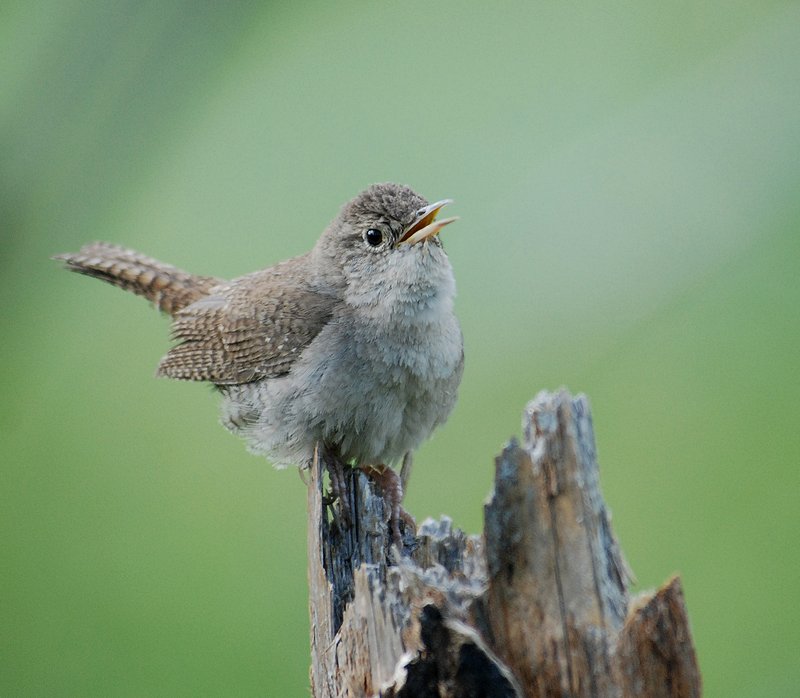
Adult northern house wrens are about 11 to 13 cm long, with a 15 cm wingspan and a weight of 10 to 12 g. Their upperparts range from dull greyish-brown to rich rufescent-brown, with blackish barring on the wings and tail, a faint eye-ring and eyebrow, a long thin bill, pinkish or grey legs, and a short tail usually held cocked.
Where to find it
The House Wren is found in southern Canada, the USA and Mexico, occurring in most suburban areas in its range and reaching high densities in floodplain forests of the western Great Plains. It forages actively in vegetation, eating insects, spiders and snails, and migrates to the southern United States and Mexico for winter.
BirdBrain regions that include this bird
- Amazon Basin
- Andean Region
- California
- Caribbean
- Central America
- Eastern Canada
- Eastern South America
- Florida
- Great Lakes
- Mexico
- Mid-Atlantic
- New England
- Northern South America
- Northwest
- Plains
- Polynesia
- Rocky Mountains
- Southeast
- Southern South America
- Southwest
- Texas
- Western Canada
Did you know?
- The name troglodytes means "hole dweller", referring to its habit of disappearing into crevices while hunting or sheltering.
- It may puncture the eggshells of other birds nesting within its territory.
- It is known to fill other birds' nests with sticks, making them unusable.
Learn the House Wren by ear
BirdBrain Academy teaches bird sounds with side-by-side listening and quizzes that use different recordings, so you learn the bird rather than one clip. Start with six free lessons, no signup needed. On your phone, Sound ID can name the birds singing around you.
Related birds
 Winter WrenWrens
 American AvocetShorebirds
 American CrowCorvids
 American GoldfinchFinches
 American KestrelFalcons
 American RobinThrushes
Species notes are adapted from Wikipedia, available under CC BY-SA 4.0, and checked for BirdBrain. Recordings come from xeno-canto under the licenses shown with each one. Photo: S. King, US NPS, Public domain, via Wikimedia Commons. Identification guidance is educational; birds vary, so confirm unusual sightings with local experts or eBird.