 BirdBrain Academy
Other · Strigiidae
Great Horned Owl sounds
Bubo virginianus
The Great Horned Owl is a large, adaptable owl of the Americas, wide-ranging and at home with varied prey.

Listen to the Great Horned Owl
Each recording below is a short excerpt with its spectrogram, a picture of the sound. Time runs left to right and higher pitches sit higher up. Play each one, then look for the same shape in the next. Different recordings of the same bird help you learn the bird, not one clip.

Recorded by Michael & Katie LaTour, Anderson Township (near Cincinnati), Hamilton County, Ohio, 2019-01-11. XC450919 on xeno-canto, CC BY-SA 4.0. Five-second excerpt.

Recorded by Doug Hynes, Goulds, Newfoundland and Labrador, 2010-04-26. XC935595 on xeno-canto, CC BY-SA 4.0. Five-second excerpt.
What to listen for
Its song is a low-pitched but loud, resonant hooting, often described as solemn or terrifying. The female's call is higher and rises in pitch at the end.
Many listeners write its call as “ho-ho-hoo hoo hoo”. Treat a written sound as a memory aid; individual birds and regions vary.
When you are most likely to hear it: Calling peaks after midnight; territorial hooting decreases in February or March at egg laying..
What it looks like
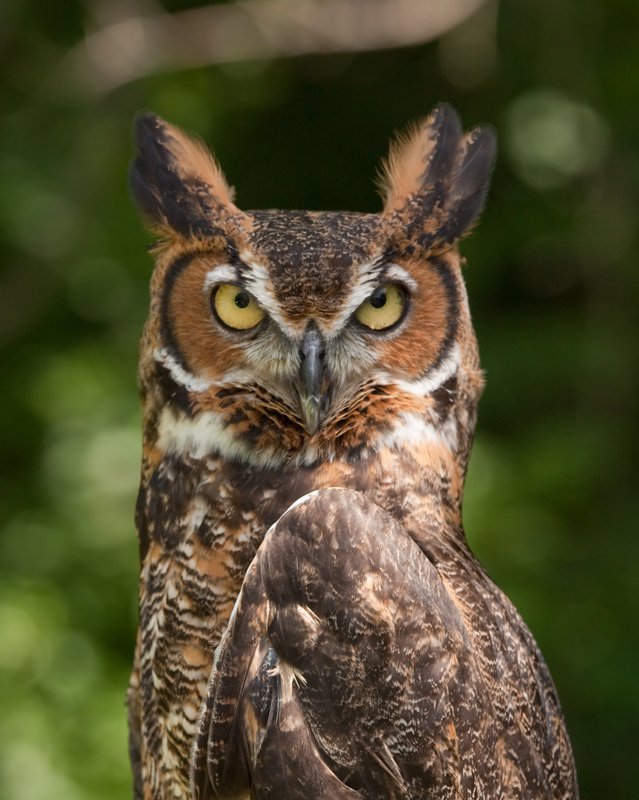
The Great Horned Owl is camouflaged in mottled brown above, lighter and barred below, with a white throat patch. It is heavily built, with a barrel-shaped body, large head, broad wings, facial disc, and prominent feather tufts.
Where to find it
It ranges through most of North America, spottily through Central America, and into South America, using forests, prairies, mountains, deserts, tundra edges, coasts, mangroves, and some urban areas. Secretive and mostly nocturnal, it roosts by day and hunts mainly from high perches.
BirdBrain regions that include this bird
- Alaska
- Amazon Basin
- Andean Region
- California
- Caribbean
- Central America
- Eastern Canada
- Eastern South America
- Florida
- Great Lakes
- Mexico
- Mid-Atlantic
- New England
- Northern South America
- Northwest
- Plains
- Polynesia
- Rocky Mountains
- Southeast
- Southern South America
- Southwest
- Texas
- Western Canada
Did you know?
- The Great Horned Owl is one of the few regular predators of skunk.
- It is among the earliest nesting birds in North America.
- Its silent flight comes from serrated, soft, fringed wing feathers.
Learn the Great Horned Owl by ear
BirdBrain Academy teaches bird sounds with side-by-side listening and quizzes that use different recordings, so you learn the bird rather than one clip. Start with six free lessons, no signup needed. On your phone, Sound ID can name the birds singing around you.
Related birds
 American AvocetShorebirds
 American CrowCorvids
 American GoldfinchFinches
 American KestrelFalcons
 American RobinThrushes
 American Tree SparrowSparrows
Species notes are adapted from Wikipedia, available under CC BY-SA 4.0, and checked for BirdBrain. Recordings come from xeno-canto under the licenses shown with each one. Photo: Greg Hume, CC BY-SA 3.0, via Wikimedia Commons. Identification guidance is educational; birds vary, so confirm unusual sightings with local experts or eBird.