 BirdBrain Academy
Creepers · Certhiidae
Carolina Wren sounds
Thryothorus ludovicianus
A common wren of eastern North America, the Carolina Wren favors dense cover and is South Carolina’s state bird.
Listen to the Carolina Wren
Each recording below is a short excerpt with its spectrogram, a picture of the sound. Time runs left to right and higher pitches sit higher up. Play each one, then look for the same shape in the next. Different recordings of the same bird help you learn the bird, not one clip.

Recorded by steve, Chapel Hill, Orange County, North Carolina, 2024-02-01. XC870688 on xeno-canto, CC BY-SA 4.0. Five-second excerpt.

Recorded by Matthias Sirch, South Hero, Grand Isle County, Vermont, 2017-07-09. XC384609 on xeno-canto, CC BY-SA 4.0. Five-second excerpt.


What to listen for
Males sing year-round through the day, with many phrase patterns repeated several times. Both sexes give alarm calls, while southern males may use a ringing alarm sound and females give paired notes or chatter.
Many listeners write its call as “teakettle-teakettle-teakettle”. Treat a written sound as a memory aid; individual birds and regions vary.
When you are most likely to hear it: Year-round, at any point during the daytime except in the harshest weather..
What it looks like
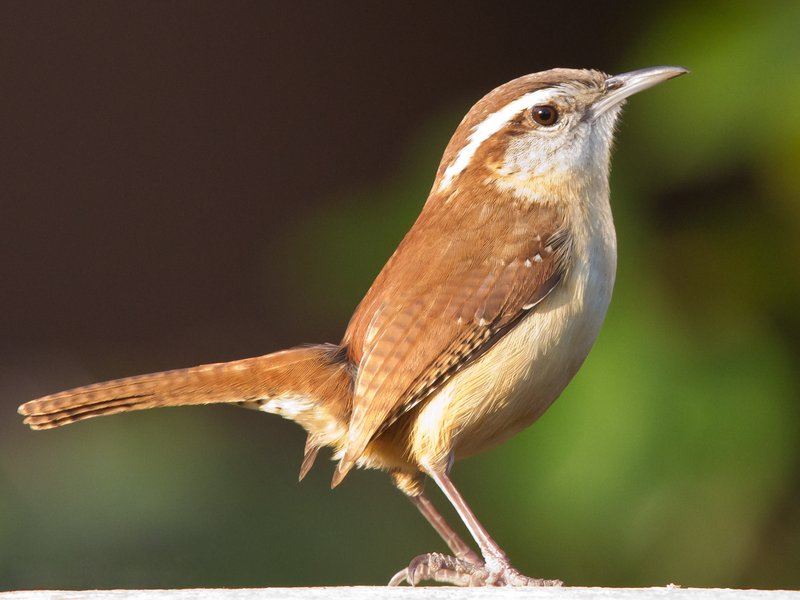
The Carolina Wren is a fairly large wren, rich brown above with a chestnut-toned rump and barred brown tail. A bold white eyebrow, gray throat, buff underparts, and light pinkish to yellowish-brown legs mark its small, watchful form.
Where to find it
It lives largely as a resident bird in woodland, brushy edges, swamps, overgrown farmland, suburban yards, parks, and places with thick shrubs or tangled undergrowth. Wary and often heard before seen, it searches near the ground, in vines, leaf litter, and lower bark crevices.
BirdBrain regions that include this bird
- Caribbean
- Central America
- Eastern Canada
- Florida
- Great Lakes
- Mexico
- Mid-Atlantic
- New England
- Plains
- Polynesia
- Southeast
- Texas
Did you know?
- Pairs maintain a territory and stay together for several years.
- Occasionally, the Carolina Wren mimics other species and has been called the “mocking wren” in Pennsylvania.
- It was featured on the back of South Carolina’s 2000 state quarter.
Learn the Carolina Wren by ear
BirdBrain Academy teaches bird sounds with side-by-side listening and quizzes that use different recordings, so you learn the bird rather than one clip. Start with six free lessons, no signup needed. On your phone, Sound ID can name the birds singing around you.
Related birds
 American AvocetShorebirds
 American CrowCorvids
 American GoldfinchFinches
 American KestrelFalcons
 American RobinThrushes
 American Tree SparrowSparrows
Species notes are adapted from Wikipedia, available under CC BY-SA 4.0, and checked for BirdBrain. Recordings come from xeno-canto under the licenses shown with each one. Photo: Dan Pancamo, CC BY-SA 2.0, via Wikimedia Commons. Identification guidance is educational; birds vary, so confirm unusual sightings with local experts or eBird.