 BirdBrain Academy
Waterfowl · Anatidae
Mallard sounds
Anas platyrhynchos
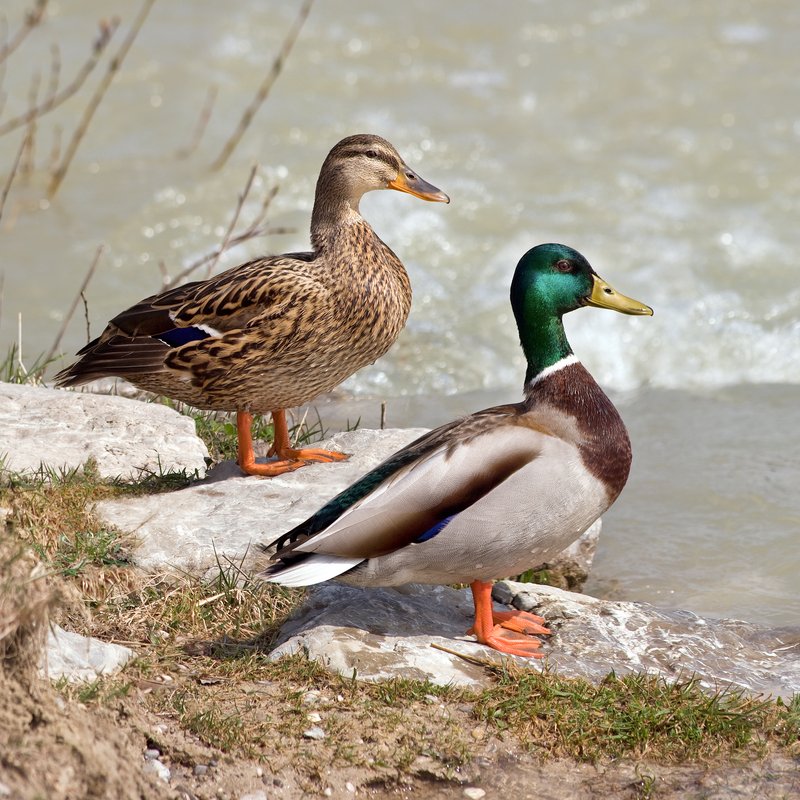
The Mallard is a widespread dabbling duck of temperate Eurasia and the Americas, the male unmistakable with its glossy green head and white collar.
Listen to the Mallard
Each recording below is a short excerpt with its spectrogram, a picture of the sound. Time runs left to right and higher pitches sit higher up. Play each one, then look for the same shape in the next. Different recordings of the same bird help you learn the bird, not one clip.

Recorded by Marie-Lan Taÿ Pamart, Jardin des Plantes (near Paris), Arrondissement de Paris, Île-de-France, 2020-01-08. XC518422 on xeno-canto, CC BY-SA 4.0. Five-second excerpt.

Recorded by Jonathon Jongsma, Powderhorn Park, Minneapolis, Hennepin, Minnesota, 2010-09-14. XC62258 on xeno-canto, CC BY-SA 3.0. Five-second excerpt.


What to listen for
The female produces the deep, stereotypical quack associated with ducks, often given in a sequence of 2–10 calls that start loud and gradually decrease in volume. The male's call is phonetically similar but deeper and quieter.
Many listeners write its call as “quack”. Treat a written sound as a memory aid; individual birds and regions vary.
What it looks like
A medium-sized waterfowl, 50–65 cm long, the male has a glossy bottle-green head, white collar, purple-tinged brown breast, grey-brown wings and a yellowish-orange bill, while the female is mottled buff and brown. Both sexes show a white-bordered iridescent purple-blue speculum on the wing.
Where to find it
The Mallard inhabits a wide range of fresh and saltwater wetlands from Arctic tundra to subtropical regions, favoring shallow water under a meter deep with aquatic vegetation. Highly gregarious outside the breeding season, it forms large flocks known as sordes.
BirdBrain regions that include this bird
- Alaska
- Amazon Basin
- Andean Region
- Arctic
- Australia
- California
- Central Asia
- Central Russia
- East Asia
- Eastern Canada
- Eastern Europe
- Eastern Russia
- Florida
- Great Lakes
- Mexico
- Mid-Atlantic
- Middle East
- New England
- New Zealand
- Northern Africa
- Northern Europe
- Northern South America
- Northwest
- Plains
- Polynesia
- Rocky Mountains
- South Asia
- Southeast
- Southern Europe
- Southwest
- Texas
- Western Canada
- Western Europe
- Western Russia
Did you know?
- Mallard vocalisations vary by environment with something akin to a regional accent — urban London birds are louder and more vociferous than rural Cornish ones.
- Mallards were the first species shown to practice unihemispheric slow-wave sleep, dozing with one eye open and half the brain awake.
- The Mallard is the seventh most hazardous bird to aircraft in the United States, with 1,320 recorded collisions since 1990.
Learn the Mallard by ear
BirdBrain Academy teaches bird sounds with side-by-side listening and quizzes that use different recordings, so you learn the bird rather than one clip. Start with six free lessons, no signup needed. On your phone, Sound ID can name the birds singing around you.
Related birds
 Blue-winged TealWaterfowl
 Canada GooseWaterfowl
 GadwallWaterfowl
 Hooded MerganserWaterfowl
 Northern PintailWaterfowl
 Northern ShovelerWaterfowl
Species notes are adapted from Wikipedia, available under CC BY-SA 4.0, and checked for BirdBrain. Recordings come from xeno-canto under the licenses shown with each one. Photo: Richard Bartz, CC BY-SA 2.5, via Wikimedia Commons. Identification guidance is educational; birds vary, so confirm unusual sightings with local experts or eBird.