 BirdBrain Academy
Waterfowl · Anatidae
Gadwall sounds
Mareca strepera
The Gadwall is a common, widespread dabbling duck in the family Anatidae.
Listen to the Gadwall
Each recording below is a short excerpt with its spectrogram, a picture of the sound. Time runs left to right and higher pitches sit higher up. Play each one, then look for the same shape in the next. Different recordings of the same bird help you learn the bird, not one clip.

Recorded by Joost van Bruggen, Arnhem, Arnhem, Gelderland, 2018-09-26. XC436359 on xeno-canto, CC BY-SA 4.0. Five-second excerpt.


What to listen for
The Gadwall is generally quiet except during courtship. Females give a higher-pitched mallard-like quack, while males give a grunt and a whistle.
Many listeners write its call as “gag-ag-ag-ag”. Treat a written sound as a memory aid; individual birds and regions vary.
What it looks like
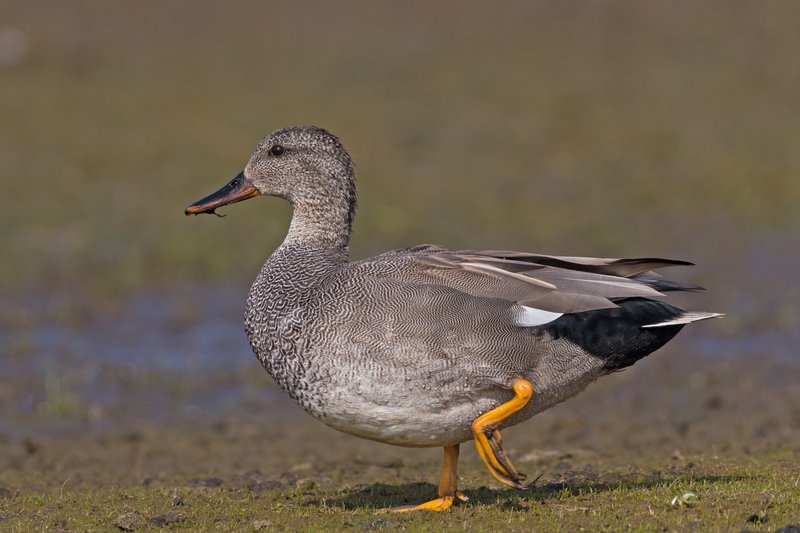
The Gadwall is 47–58 cm long, with the male patterned grey, black at the rear, and marked by light chestnut wings and a bright white speculum. The female is light brown like a female mallard, but smaller, with a dark orange-edged bill, white speculum, and white belly.
Where to find it
The Gadwall lives in open wetlands such as prairie or steppe lakes, wet grassland, and marshes with dense fringing vegetation. It feeds mostly by dabbling with its head submerged, can dive for food, and may steal food from diving birds such as coots.
BirdBrain regions that include this bird
- Alaska
- California
- Central Asia
- Central Russia
- East Asia
- Eastern Canada
- Eastern Europe
- Florida
- Great Lakes
- Mexico
- Mid-Atlantic
- New England
- Northern Europe
- Northwest
- Polynesia
- Rocky Mountains
- South Asia
- Southeast
- Southeast Asia Mainland
- Southern Europe
- Southwest
- Texas
- Western Canada
- Western Europe
- Western Russia
Did you know?
- The Gadwall can dive underwater for food more proficiently than other dabbling ducks.
- It may steal food from diving birds such as coots.
- Gadwalls are monogamous and may start breeding after their first year.
Learn the Gadwall by ear
BirdBrain Academy teaches bird sounds with side-by-side listening and quizzes that use different recordings, so you learn the bird rather than one clip. Start with six free lessons, no signup needed. On your phone, Sound ID can name the birds singing around you.
Related birds
 Blue-winged TealWaterfowl
 Canada GooseWaterfowl
 Hooded MerganserWaterfowl
 MallardWaterfowl
 Northern PintailWaterfowl
 Northern ShovelerWaterfowl
Species notes are adapted from Wikipedia, available under CC BY-SA 4.0, and checked for BirdBrain. Recordings come from xeno-canto under the licenses shown with each one. Photo: Andreas Trepte, CC BY-SA 2.5, via Wikimedia Commons. Identification guidance is educational; birds vary, so confirm unusual sightings with local experts or eBird.