 BirdBrain Academy
Waterfowl · Anatidae
Canada Goose sounds
Branta canadensis
A large black-headed goose native to North America, often near fresh water and adept at living in human-altered places.

Listen to the Canada Goose
Each recording below is a short excerpt with its spectrogram, a picture of the sound. Time runs left to right and higher pitches sit higher up. Play each one, then look for the same shape in the next. Different recordings of the same bird help you learn the bird, not one clip.

Recorded by Doug Hynes, Landing Lake, Churchill, MB, 2010-06-06. XC934272 on xeno-canto, CC BY-SA 4.0. Five-second excerpt.

Recorded by Jonathon Jongsma, Wild River State Park, Chisago County, Minnesota, 2014-05-11. XC178135 on xeno-canto, CC BY-SA 4.0. Five-second excerpt.

Recorded by Jonathon Jongsma, Wild River State Park, Chisago County, Minnesota, 2014-05-11. XC178135 on xeno-canto, CC BY-SA 4.0. Five-second excerpt.
What to listen for
The male gives a honk, while the female gives a shorter, higher-pitched hrink. When agitated or defending territory, Canada geese may begin with a high-pitched hiss.
Many listeners write its call as “honk”. Treat a written sound as a memory aid; individual birds and regions vary.
What it looks like
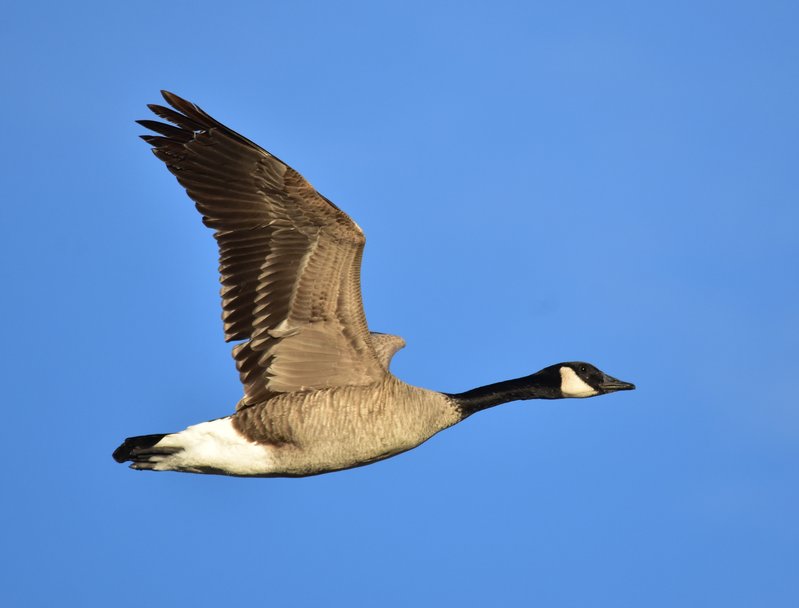
The Canada Goose has a black head and neck, a white chinstrap, white cheeks, and brown body plumage. It ranges from 75 to 110 cm long, with a wingspan of 127 to 185 cm.
Where to find it
Native to North America, it breeds in Canada and the northern United States across a wide range of habitats, often living year-round in parts of its breeding range. Naturally migratory, it often flies in V-shaped formations, while some populations remain in urban environments where food and water are abundant.
BirdBrain regions that include this bird
- Alaska
- California
- Eastern Canada
- Eastern Europe
- Florida
- Great Lakes
- Mexico
- Mid-Atlantic
- New England
- New Zealand
- Northern Europe
- Northwest
- Plains
- Rocky Mountains
- Southeast
- Southern Europe
- Southwest
- Texas
- Western Canada
- Western Europe
- Western Russia
Did you know?
- Calls from large V-shaped flocks signal the transitions into spring and autumn.
- The giant Canada goose was believed extinct until a small flock was found in Minnesota in 1962.
- Some Canada geese have become year-round residents in urban environments.
Learn the Canada Goose by ear
BirdBrain Academy teaches bird sounds with side-by-side listening and quizzes that use different recordings, so you learn the bird rather than one clip. Start with six free lessons, no signup needed. On your phone, Sound ID can name the birds singing around you.
Related birds
 Blue-winged TealWaterfowl
 GadwallWaterfowl
 Hooded MerganserWaterfowl
 MallardWaterfowl
 Northern PintailWaterfowl
 Northern ShovelerWaterfowl
Species notes are adapted from Wikipedia, available under CC BY-SA 4.0, and checked for BirdBrain. Recordings come from xeno-canto under the licenses shown with each one. Photo: USFWS Mountain-Prairie, Public domain, via Wikimedia Commons. Identification guidance is educational; birds vary, so confirm unusual sightings with local experts or eBird.