 BirdBrain Academy
Uncategorized ·
Cooper's Hawk sounds
Accipiter cooperii
The Cooper's Hawk is a medium-sized North American hawk, agile in pursuit of small-to-medium birds and other prey.

Listen to the Cooper's Hawk
Each recording below is a short excerpt with its spectrogram, a picture of the sound. Time runs left to right and higher pitches sit higher up. Play each one, then look for the same shape in the next. Different recordings of the same bird help you learn the bird, not one clip.

Recorded by Diana Doyle, Sierra Vista, Cochise County, Arizona, 2019-06-27. XC483616 on xeno-canto, CC BY-SA 4.0. Five-second excerpt.

Recorded by Jonathon Jongsma, Powderhorn Park, Minneapolis, Hennepin, Minnesota, 2011-03-31. XC74741 on xeno-canto, CC BY-SA 3.0. Five-second excerpt.

Recorded by J. R., Laurelwood Park, San Mateo County, California, 2020-07-26. XC579251 on xeno-canto, CC BY-SA 4.0. Five-second excerpt.
What to listen for
The typical call is a harsh, cackling yelp, with males usually higher pitched, less raspy, and faster paced than females. Many calls occur around breeding, courtship, food delivery, and nest interactions, while Cooper's Hawks are generally silent outside the breeding season.
Many listeners write its call as “keh-keh-keh”. Treat a written sound as a memory aid; individual birds and regions vary.
When you are most likely to hear it: During the breeding season, including dawn chorus; generally silent outside the breeding season..
What it looks like
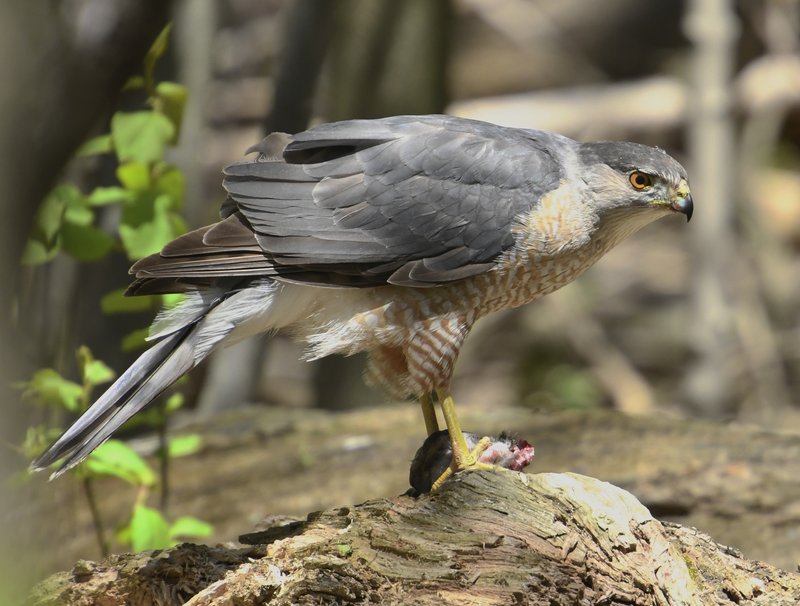
The Cooper's Hawk is medium-sized, with moderate-length wings, a long often rounded or wedge-shaped tail, long legs, and a large squarish head. Adults are blue-gray or brown-gray above with a blackish-brown crown, barred tail, rufous to cinnamon barring below, and orange to red eyes; juveniles are darker brown above and streaked below.
Where to find it
It ranges from southern Canada to northern Mexico, using deciduous, mixed, conifer, foothill, riparian, farmland, urban, and suburban wooded habitats. The Cooper's Hawk tends to be active earlier in the morning, roosts in conifers, favors forest edges and clearings, and can adapt to cities where wooded cover and prey are available.
BirdBrain regions that include this bird
- California
- Caribbean
- Eastern Canada
- Florida
- Great Lakes
- Mexico
- Mid-Atlantic
- New England
- Northwest
- Plains
- Polynesia
- Rocky Mountains
- Southeast
- Southwest
- Texas
- Western Canada
Did you know?
- Other common names include big blue darter, chicken hawk, flying cross, hen hawk, quail hawk, striker, and swift hawk.
- Juvenile Cooper's Hawks have been recorded lying on their backs along branches or the ground, apparently as sunning behavior.
- Some authors claimed breeding Cooper's Hawks may utter well over 40 call variations.
Learn the Cooper's Hawk by ear
BirdBrain Academy teaches bird sounds with side-by-side listening and quizzes that use different recordings, so you learn the bird rather than one clip. Start with six free lessons, no signup needed. On your phone, Sound ID can name the birds singing around you.
Related birds
 Fish CrowUncategorized
 Great EgretUncategorized
 Red-breasted MerganserUncategorized
 American AvocetShorebirds
 American CrowCorvids
 American GoldfinchFinches
Species notes are adapted from Wikipedia, available under CC BY-SA 4.0, and checked for BirdBrain. Recordings come from xeno-canto under the licenses shown with each one. Photo: Mykola Swarnyk, CC BY-SA 3.0, via Wikimedia Commons. Identification guidance is educational; birds vary, so confirm unusual sightings with local experts or eBird.