 BirdBrain Academy
Woodpeckers · Picidae
Pileated Woodpecker sounds
Dryocopus pileatus
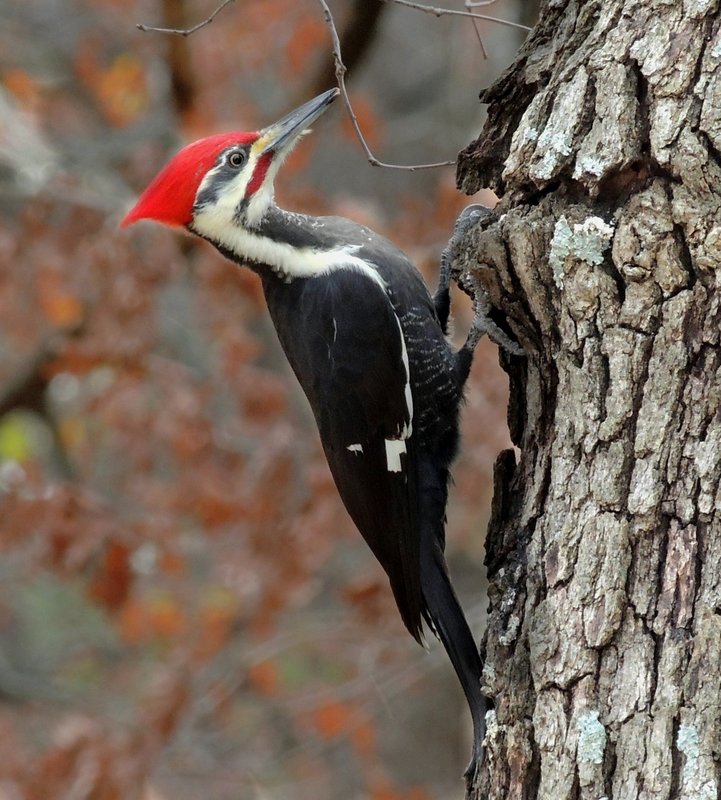
A crow-sized North American woodpecker with a red crest, white neck stripe, and mostly black body.

Listen to the Pileated Woodpecker
Each recording below is a short excerpt with its spectrogram, a picture of the sound. Time runs left to right and higher pitches sit higher up. Play each one, then look for the same shape in the next. Different recordings of the same bird help you learn the bird, not one clip.

Recorded by Jonathon Jongsma, Tettegouche State Park, Lake, Minnesota, 2010-08-31. XC61518 on xeno-canto, CC BY-SA 3.0. Five-second excerpt.

Recorded by Jonathon Jongsma, Forestville/Mystery Cave State Park, Fillmore County, Minnesota, 2015-05-09. XC241106 on xeno-canto, CC BY-SA 4.0. Five-second excerpt.

Recorded by Jonathon Jongsma, Carver Park Reserve, Carver, Minnesota, 2011-02-19. XC71727 on xeno-canto, CC BY-SA 3.0. Five-second excerpt.
What to listen for
Many listeners write its call as “woick”. Treat a written sound as a memory aid; individual birds and regions vary.
What it looks like
Pileated woodpeckers are mainly black with a red crest, a white line down the throat sides, and white wing feathers visible in flight. Adults are 40-49 cm long, with males showing a red line from bill to throat and females a black one.
Where to find it
The Pileated Woodpecker lives in forested areas across Canada, the eastern United States, and parts of the Pacific Coast, favoring mature forests and heavily wooded parks. It chips large, roughly rectangular holes in trees while searching for insects, especially ant colonies.
BirdBrain regions that include this bird
- Alaska
- California
- Caribbean
- Eastern Canada
- Florida
- Great Lakes
- Mexico
- Mid-Atlantic
- New England
- Northwest
- Plains
- Rocky Mountains
- Southeast
- Southwest
- Texas
- Western Canada
Did you know?
- It is famous for making large, nearly rectangular carvings in trees to reach prey or make a nest.
- Pairs typically stay together for life once they have found a mate.
- Their abandoned nesting holes can later shelter forest songbirds, owls, tree-nesting ducks, and other animals.
Learn the Pileated Woodpecker by ear
BirdBrain Academy teaches bird sounds with side-by-side listening and quizzes that use different recordings, so you learn the bird rather than one clip. Start with six free lessons, no signup needed. On your phone, Sound ID can name the birds singing around you.
Related birds
 Downy WoodpeckerWoodpeckers
 Hairy WoodpeckerWoodpeckers
 Northern FlickerWoodpeckers
 Red-bellied WoodpeckerWoodpeckers
Species notes are adapted from Wikipedia, available under CC BY-SA 4.0, and checked for BirdBrain. Recordings come from xeno-canto under the licenses shown with each one. Photo: Joshlaymon, CC BY-SA 3.0, via Wikimedia Commons. Identification guidance is educational; birds vary, so confirm unusual sightings with local experts or eBird.